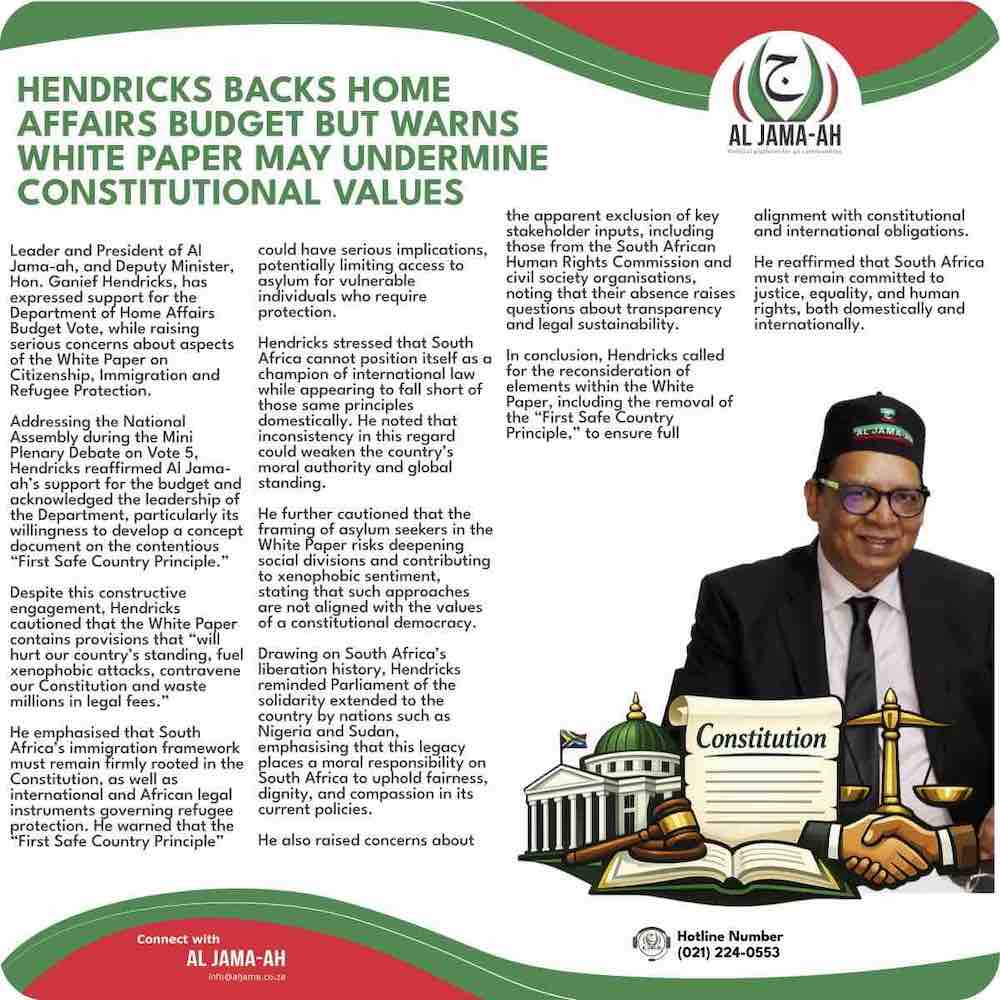
Leader and President of Al Jama-ah, and Deputy Minister, Hon. Ganief Hendricks, has expressed support for the Department of Home Affairs Budget Vote, while raising serious concerns about aspects of the White Paper on Citizenship, Immigration and Refugee Protection.
Addressing the National Assembly during the Mini Plenary Debate on Vote 5, Hendricks reaffirmed Al Jama-ah’s support for the budget and acknowledged the leadership of the Department, particularly its willingness to develop a concept document on the contentious “First Safe Country Principle.”
Despite this constructive engagement, Hendricks cautioned that the White Paper contains provisions that “will hurt our country’s standing, fuel xenophobic attacks, contravene our Constitution and waste millions in legal fees.”
He emphasised that South Africa’s immigration framework must remain firmly rooted in the Constitution, as well as international and African legal instruments governing refugee protection. He warned that the “First Safe Country Principle”
could have serious implications, potentially limiting access to asylum for vulnerable individuals who require protection.
Hendricks stressed that South Africa cannot position itself as a champion of international law while appearing to fall short of those same principles domestically. He noted that inconsistency in this regard could weaken the country’s moral authority and global standing.
He further cautioned that the framing of asylum seekers in the White Paper risks deepening social divisions and contributing to xenophobic sentiment, stating that such approaches are not aligned with the values of a constitutional democracy.
Drawing on South Africa’s liberation history, Hendricks reminded Parliament of the solidarity extended to the country by nations such as Nigeria and Sudan, emphasising that this legacy places a moral responsibility on South Africa to uphold fairness, dignity, and compassion in its current policies.
He also raised concerns about
the apparent exclusion of key stakeholder inputs, including those from the South African Human Rights Commission and civil society organisations, noting that their absence raises questions about transparency and legal sustainability.
In conclusion, Hendricks called for the reconsideration of elements within the White Paper, including the removal of the “First Safe Country Principle,” to ensure full
alignment with constitutional and international obligations.
He reaffirmed that South Africa must remain committed to justice, equality, and human rights, both domestically and internationally.