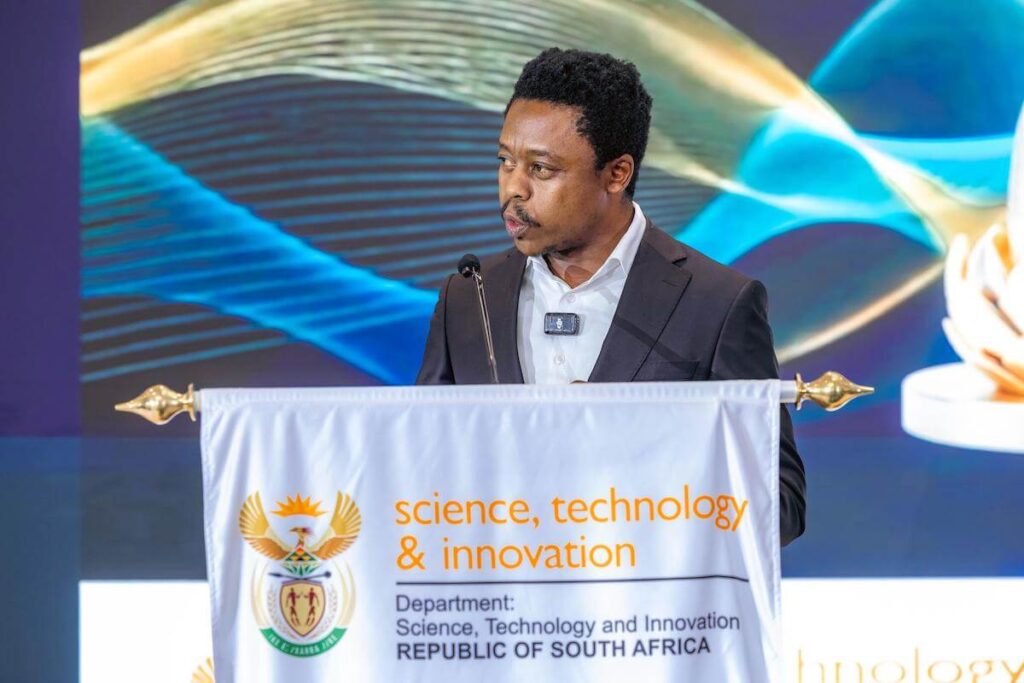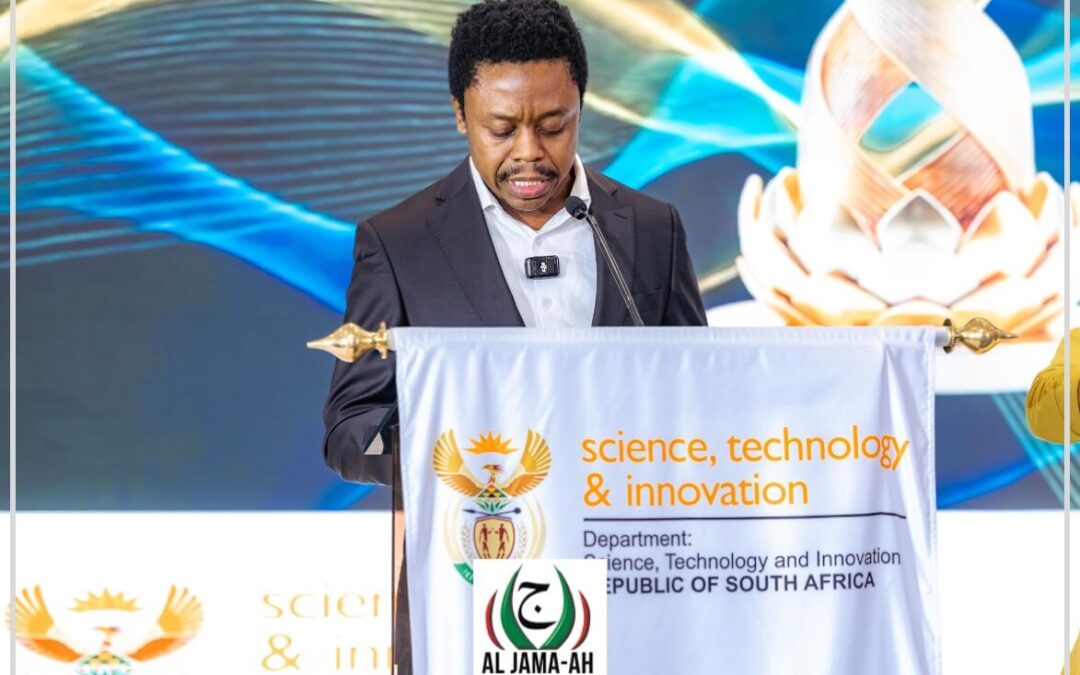
On behalf of the Council and the people of Johannesburg cllr Thapelo Amad MMC for community development received Minister Blade Nzimade of the department of science, technology & innovations on behalf of the Executive Mayor of Johannesburg cllr Dada Morero:
A qoute from councillor Amad:
“It is my privilege to welcome you to our city and to the 2026 South African Women in Science Awards. We are honoured that Johannesburg is hosting this celebration of knowledge, courage and public purpose during National Women’s Month.
I extend our appreciation to the Honourable Minister and the Department of Science, Technology and Innovation for sustaining SAWISA since 2003.
For more than two decades, these awards have done important work: recognising excellence, making achievement visible, and ensuring that a new generation of women can see themselves not at the margins of science, but at its very centre.
Johannesburg is a fitting place for this gathering. Ours is a city shaped by discovery, enterprise and constant reinvention. It is also a city in which the great challenges of our time are experienced at metropolitan scale: inequality, climate change, energy security, water resilience, public health, mobility, housing and digital inclusion.
These challenges remind us that science is not remote from the daily life of a city. It is present whenever a reservoir is monitored, an electricity network is stabilised, a disease is tracked, a transport system is redesigned, or a neighbourhood is made safer and more liveable.
The theme for this year’s awards, ‘Placing Women at the Centre of Science, Technology and Innovation’, is therefore both timely and demanding.
It cannot remain a ceremonial phrase. It must describe how our institutions are organised, how research priorities are set, how funding is allocated, whose knowledge is trusted, and who has the authority to shape the future. Placing women at the centre is not simply about inviting women into systems designed without them.
It is about changing those systems so that women’s talent, insight and leadership can flourish.
The breadth of SAWISA is especially important. The natural, life, physical and engineering sciences help us understand and transform the material world. The human and social sciences help us understand power, behaviour, inequality, trust and the institutions through which change must occur.
Public engagement with science connects knowledge to communities and strengthens confidence in evidence. The special theme, ‘Innovation for Impact: Women Leading Change’, reminds us that the value of knowledge is ultimately measured by the difference it makes in people’s lives. The fellowships for master’s and doctoral students invest in the next generation who will carry this work forward.
National Women’s Month also requires honesty. Women have never been peripheral to scientific discovery or innovation. Too often, however, their contributions have been undervalued, underfunded or made invisible. Recognition matters because it corrects the public record and expands the horizon of what young people believe is possible.
But recognition on its own is not enough.”